Such a high value means that gold is a relatively scarce commodity compared to, say, silver, which has its SF value at 22.
During 2019, when this table was released, Bitcoin’s SF value was 25, which means it was scarcer than silver, but not gold.
However, there is one thing to note here. BTC is different to gold and other metals in that their S2F value won’t practically increase much.
Current stock-to-flow value of Bitcoin is around 49, which means the cryptocurrency has only gotten scarcer over the years.
The reason behind BTC’s S2F value sharply going up is the halving (where flow is halved). With each halving, the coin will continue to get scarcer.
Now, here is how the S2F value correlates with the price.
Model price (USD) = exp(-1.84) * SF ^ 3.36
The model is based on the above formula. This is how the chart was generated. Looking back at which, in 2019 almost the same amount of deviation was observed as in 2021 right now.
The 2019 price went back in line with the chart shortly after, while it remains to be seen whether the same will happen this time.
Bitcoin Price
At the time of writing, BTC‘s price is around $33k. It’s down about 5% in the last 7 days, and almost 8% in the past month.
BTC seems to be going down again | Source: BTCUSD on TradingView
Bitcoin seems to be in a bear market right now, but if the S2F model holds true, the price should go up soon to remain in line with it. The next few months will be a real test for the method.
Total Locked Value (TLV) of 10M was reached in the first 4 hours of the farming program.
Free TON, a community-driven blockchain with decentralized governance, has announced its 15M TON Yield Farming program will take place on TON Swap (Free TON’s DEX is powered by Broxus). In addition, the WTON-USDT pair will be hosted both on Uniswap and TON Swap.
Today, June 29, the first stage of farming begins, with the second stage expected to start by the end of the week. The rewards for liquidity providers will be given within two months.
In broad terms, yield farming is similar to staking. Community members supply an asset to a liquidity pool and that is then used to generate interest, or yield. In return for providing assets, users are rewarded based on the amount they submit to the pool.
Free TON has recently committed to adding $1B in liquidity before the end of 2021. Most of the network’s tokens will be put into Yield Farming in order to attract other significant DeFi protocols as well as to add more liquidity to Free TON and pull more liquidity from Ethereum before the launch of Ethereum 2.0.
Free TON is a fast, secure, and scalable network, which can process millions of transactions per second thanks to its unique dynamic sharding technology. It is on a mission to drive widespread adoption of decentralized solutions by millions of users.
Other unique features of Free TON in addition to its infinite sharding paradigm include instant hypercube routing, proof-of-stake mechanics to validate new blocks, an ability to configure network parameters by voting, and many more.
Robinhood has been fined by FINRA and the finance company will have to pay roughly $70 million in penalties. The company was fined for causing what was described as “widespread and significant” harm to customers.
FINRA announced that it had fined Robinhood $57 million. And ordered the company to pay $12.6 million in damages to customers, plus interest. Bringing the total amount to roughly $13 million to be paid in damages.
This penalty is the largest penalty ever ordered by the Financial Industry Regulatory Authority. FINRA is a non-governmental, self-regulatory organization that oversees the brokerage industry.
What Triggered This?
FINRA cited that Robinhood had caused customers significant harm by showing them incorrect balances.
One of such cases had led to the suicide of a 20-year-old customer. In the suicide note left behind, the customer says that they did not believe they had turned on margin trading. And yet somehow, Robinhood had let them trade with borrowed money. Leading to massive losses for the customers.
The platform had shown the customer that he had a negative balance of $730,165. Losses that were incurred from using the margin trading feature. When in fact, the customer had a balance of $365,530.60.
There have been numerous allegations of Robinhood showing customers wrong balances.
According to FINRA, the 20-year-old was not the only victim of this. More than 800,000 Robinhood customers had been allowed to make trades that automatically triggered margin trading. Allowing users to trade with borrowed money. This would happen regardless of whether they had turned on the margin trading feature or not.
According to them, Robinhood had failed to establish and maintain an adequate system for complying with regulations.
“Compliance with these rules is not optional and cannot be sacrificed for the sake of innovation and willingness to ‘break things’ and fix them later.” – Jessica Hopper, Head of FINRA’s Enforcement Department
The creation of fraud accounts on the platform was also another issue cited. Apparently, Robinhood had authorized the opening of accounts even though they were warned that these accounts might be fraudulent.
There were more than 100 accounts that had social security numbers that may belong to deceased people.
Containing on further, FINRA also alleged that Robinhood had failed to report tens of thousands of complaints that the company was obligated to report.
Robinhood’s Response
Robinhood has neither confirmed nor denied the allegations levied by FINRA. But the company did reply to the action being taken by FINRA against them. The company ensured that Robinhood had invested heavily to improve the platform.
“Robinhood has invested heavily in improving platform stability, enhancing educational resources, and building out customer support and legal and compliance terms. We are glad to put this behind us and look forward to continuing to focus on our customers and democratizing finance for all.” – Jacqueline Ortiz Ramsay, Head of Public Policy Communications at Robinhood.
Robinhood was founded in 2013 and has been in operation ever since. Headquartered in Menlo Park, the American financial company offers commission-free trades on stocks and exchange-traded funds. They do this through the mobile app that they released in 2015.
Robinhood rose to prominence with the explosion of “meme stocks” during the pandemic. Stocks like GameStop were traded based on social media sentiment and Robinhood was the primary medium for most investors.
Robinhood had already set aside $26.6 million in preparation for the fine which they predicted was coming. But the fine turned out to be more than double the amount they had speculated.
This will not be the first time the company is getting fined by FINRA. Robinhood had been fined $1.25 million earlier in 2019 for best execution violations.
It is not yet known when Robinhood will pay out the fines and settlement. But the company looks ready to move forward from this as quickly as possible.
Featured image from Two Oxen, chart from TradingView.com
As Bitcoin struggles to make a decisive move upwards, big news has had little effect to aid the bulls during this ongoing sell-off. From Morgan Stanley buying 28,000 shares of the Grayscale Bitcoin Trust (GBTC) to MicroStrategy holding over 100,000 BTC, to 640 banks in the U.S. offering BTC to their clients, many announcements have gone relatively unnoticed as BTC’s price bleeds.
The entry of the investment giant Soros Fund Management into the crypto market could have the same fate. The investment firm has $28 billion in assets under management and has begun to actively trade Bitcoin, according to a report by TheStreet.
This news website cites two sources familiar with the matter. The firm executives gave the green light for the operation and could trade with other cryptocurrencies.
These events have an apparently small impact on BTC’s price, in the long run, they could create more demand or push down the market. It depends on how the Soros Fund will trade Bitcoin.
In the crypto community, some have begun to speculate on the possible effect on the market. Pseudonym trader and analyst Byzantine General jokingly tweeted about a “massive wallet inflow bubble” when BTC’s price was at $32,000 and asked his followers: Did Soros acquire a bag?
Yes, you read that right. That’s a 163,300 bitcoin inflow which is still sitting there in the wallet it got sent to.
The investment firm’s founder George Soros is also known as “The man who broke the bank of England”. This is due to a short position that he took against the British pound sterling that made him a profit of over $1 billion during the currency crisis of 1992.
Bitcoin At An Infection Point? A True Hedge Against Inflation
On the other hand, it’s positive that BTC adoption continues to rise amongst institutions such as the Soros Fund Management. Back in March 2021, its CIO Dawn Fitzpatrick talked about how Bitcoin was at an inflection point.
At that moment, she revealed that the firm made investments in crypto infrastructure and praised the industry for its significant maturation. An asset such as BTC becomes more relevant in the current macro-economic environment. The Soros Fund CIO said:
When it comes to crypto in general, I think we are at an important moment in time. Something like Bitcoin could have remained a static asset, but the fact that in the last 12 months we have increased the money supply by 25%, there is a real fear of currency devaluation.
For Fitzpatrick, BTC is a commodity, a physical asset with better features than gold. With the rise of central bank digital currencies (CBDC), the executive believes BTC will gain more relevance. This narrative has been gaining momentum as China moves to further test its digital yuan.
Digitalization allows people to optimize and accelerate many processes. For example, we have messengers for rapid communications and electronic wallets to make quick payments for goods and services.
Unfortunately, most services require separate applications that clog up device memory and create confusion. The developers at XQR have found a solution to this problem. We suggest you take a closer look at this startup project, which many call a multifunctional social network of the future.
What exactly is XQR?
XQR’s developers position the project as a social network with advanced functionality that covers several user needs at once. For example, each account can be considered an information center for a particular person or company, and the platform itself can be considered a place to communicate, find goods and services, and establish business contacts.
Among other things, XQR allows you to earn money. The developers have created a number of monetization tools that ensure users can make a profit. For example, you can mine cryptocurrency on the platform and earn income for attracting new users.
Since there are no similar products on the market, the concept for XQR may seem complicated. In fact, on closer inspection, the multifunctional platform looks like a simple, logically verified set of technical innovations. We suggest that you delve deeper into how this project works.
XQR as a Universal Calling Card
The platform invites everyone to create a page that can be considered a personal information center. The interface for an XQR user account consists of a number of sections, including the following:
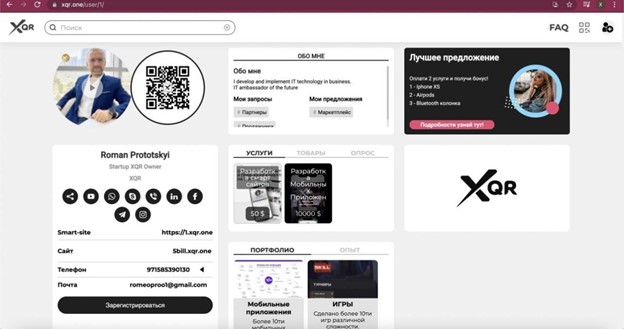
Basic information, including the user’s full name, place of work, links to social networks, web address, and phone number. This section also contains an individual QR code that will take anyone you share it with to your page. Thus, XQR is a universal tool for presenting yourself, like a virtual 21st century calling card.
Interesting! Through XQR, you can share contacts even without a network connection. When scanning a QR code, a phone automatically adds the user to its address book.
Information about professional interests, including requests and suggestions. You can search this field to find new business partners and clients.
A blog containing services and products that the page owner is ready to create or provide.
Portfolio and information about work experience.
Screenshot of XQR User Page
Important! A personal page in XQR is comparable to having your own website. A person doesn’t need to download the platform’s mobile application to access it. The page will automatically open in a phone’s browser when the user’s QR code is scanned.
The platform has a search field that makes it easy to find company representatives, specialists in a certain profession, and so on.
As of the end of June 2021, 3,000 users were registered on XQR. The service’s main features are available for free.
A Glance at the Technical Side of the Project
XQR is a modular project. It consists of a number of products that form the platform’s ecosystem.
Here are some XQR modules:
An internal wallet, which users can use to make various settlements.
A marketplace offering crypto cashback for purchases on the platform. On average, users will be able to recoup about 5% of the cost of a product or service.
Referral program: XQR pays out Bitcoin (BTC) and Tether (USDT) for attracting new users.
In the future, the developers plan to add other modules that will expand the project’s ecosystem. As a result, XQR will become a universal platform where users can find everything from taxi services to investors for their startup.
How do you mine cryptocurrency through XQR?
Users can get started earning cryptocurrency on XQR without any special knowledge or skills.
Bitcoin (BTC) mining is available on XQR. In the future, users will also be able to mine the project’s 5BILL token. You’ll find out more about XQR’s native cryptocurrency later in this review.
You can receive tokens in the games presented on the platform or by completing small tasks. For example, the platform will pay crypto coins for inviting new users to XQR.
Interesting! Earning cryptocurrency in this way cannot technically be called ‘mining’ in the traditional sense. That process usually involves making a device’s computing power available to a digital asset’s network.
Mining on XQR more closely resembles the distribution of cryptocurrency on platforms called ‘faucets’, in which users can receive coins for completing simple tasks.
Why does XQR need an internal token?
Having its own cryptocurrency has made it possible for XQR to unify the project’s financial system by linking its individual products. Instead of various currencies, the developers offer users a universal tool – the 5Bill token. With its help, the project plans to reward users in many different ways.
We’ve already mentioned that XQR’s system will transfer cashback to users for purchases made in its marketplace and pay them for attracting new users. With the help of the token, other actions will be monetized in the future. For example, users of XQR’s social network will be able to encourage other users with small payments.
How was XQR developed?
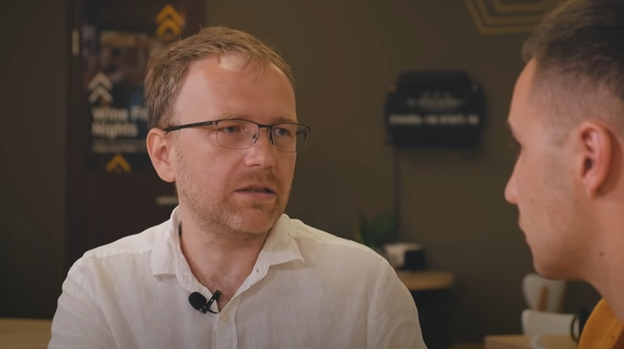
The creator of the project is a cyber security specialist named Roman Prototsky, who has devoted the last 12 years of his life to the IT field. The developer had his own studio, where he created custom-made mobile applications, websites, games, Telegram bots, and various services.
Roman Prototsky. A screenshot from a video about the XQR project from the UkrInvestClub YouTube channel
Roman Prototsky’s many years of experience in development helped him create his own high-tech project that meets the requirements of modern users.
He began working on XQR in 2019. A development team helps him in creating the project.
Who can the project be useful for?
XQR is a multifunctional project. We suggest you consider the basic ways of using the platform:
As a business page. A user can store all the information needed to present themself or their business in one place. To share it, it is enough to display an individual QR code that will automatically take anyone who scans it to the user’s page.
As a communication service. Users will be able to communicate inside the platform.
To search for partners, products, and services. The platform’s interface allows users not only to find people and companies via specific search criteria, but also to place orders for goods and services on XQR’s marketplace.
The referral program and other earning opportunities, including mining functionality, makes it possible to consider the project a source of income.
How do you register on XQR?
To register on the platform, it is enough to specify a mobile phone number, come up with a password, and confirm the creation of the account by entering a code that the system will send you in an SMS.
The developers have posted detailed instructions on the project’s YouTube channel:
The XQR platform is also available for Android and iOS users.
Why is XQR better than other social networks?
The platform saves time. The user has maximum opportunities within a single interface.
XQR is secure. The platform utilizes blockchain technology to protect its users’ accounts. The project’s technical characteristics prevents information from getting to third parties. Accordingly, XQR will not repeat the follies of Facebook, which provided user data to Cambridge Analytica, or the lapses of LinkedIn, whose client base was leaked on the web.
The project is ready to share profits with its users. To start earning on XQR, it’s enough to register and connect to the referral program.
You can mine cryptocurrency on XQR. This and other earning mechanisms make the platform financially attractive.
Conclusions
XQR’s developers have decided to take all the best tools from the world of digital technology and combine them in one universal platform. As of the end of June 2021, the platform is still being refined, but its basic modules are already fully functioning.
XQR makes it possible to significantly simplify business communications and many other processes, as well as search for people and products. Given the accelerating pace of life, the project’s features look especially relevant today.
The congressional hearing hilariously titled “America on ‘FIRE:’ Will the Crypto Frenzy Lead to Financial Independence and Early Retirement or Financial Ruin?” is the gift that keeps on giving. NewsBTCalready analyzedsome aspects of it, but Peter Van Valkenburgh’s testimony merits an article on its own. The Director of Research at Coin Center got several important ideas on the record, and we’d better register and remember them.
The previous article’s introduction still stands:
The U.S. Congress Oversight and Investigations Subcommittee held a hybrid hearing on Bitcoin and cryptocurrencies. The institution summoned Alexis Goldstein, Director of Financial Policy for the Open Market Institute, Sarah Hammer, Managing Director at the Stevens Center for Innovation in Finance, Peter Van Valkenburgh, Director of Research at Coin Center, and others.
Since we at NewsBTC already did the job and covered the ridiculous statements of Representative Brad Sherman, it’s time to give the mic to someone more qualified and informed. Let the record reflect that a full video of the whole hearing is not available at the time of writing. We’ll base our report on everything we could find on the open Internet.
U.S. House of Representatives, "We have the #Bitcoin Lightning Network to bundle millions of transactions without a meaningful increase of energy" – @Valkenburghpic.twitter.com/xXy9lCqAXN
— Documenting Bitcoin 📄 (@DocumentingBTC) June 30, 2021
What We Know About Peter Van Valkenburgh’s testimony
Luckily for us, Documenting Bitcoin preserved the best bit of Van Valkenburgh’s presentation. The Director of Research at Coin Center sets everything up by explaining why and how the Bitcoin network is censorship-resistant.
“… we have the advantage of knowing everything that the peer-to-peer ledger tells us. It’s shared and open, it’s not a proprietary standard from a corporation. And the peer-to-peer ledger shows us how much work these miners are performing to make sure that transactions get in blocks and they’re not censored by some third party or some government that wants to coerce certain transactions or block certain transactions. It’s this vibrant competition between miners that guarantees that the miner cannot form a cartel, and choose to systematically exclude certain persons from this financial system.”
This competition is healthy because it means that the effort spent securing the network scales automatically with the value of the transaction data on the blockchain—not the number of transactions. So the more value there is riding on the Bitcoin network (because individuals value it more as reflected in the price), the more resources will be devoted to its security.
This leads us to…
What About Bitcoin’s Energy Usage And The Lightning Network?
This man is a House of Representativesveteran. He knew what he was doing. Van Valkenburgh set everything up, and then he goes to the meat and potatoes of the testimony. He goes for the throat and flips the establishment’s argument about Bitcoin’s energy consumption on its head. He shifted the narrative and put a spotlight on the traditional financial sector’s known inefficiencies.
“As far as energy usage, it’s worth noting that the traditional financial sector uses an estimated five times more energy than Bitcoin. Granted, the traditional financial sector moves more money. But it’s worth noting that Bitcoin’s energy usage doesn’t scale per transaction. So, most of the costs are the fixed cost of setting up an open peer-to-peer system that’s robust. And we have thechnologies like the Lightning Network that can bundle millions of transactions into that existing system without a meaningful increase in energy. So, it’s possible that we can have an open financial system that’s censorship resistant using one fifth of the energy of the current financial system.”
So yeah, the Lightning Network and its wonders are registered in the U.S. House of Representatives’ record. And, even though Bitcoin’s aim is not to outright substitute the ”current financial system,” the record reflects that Bitcoin is more energy-efficient, plus censorship-resistant as a bonus. Lastly, it’s worth noting that “five times more energy than Bitcoin” is an extremely generous estimate in favor of the traditional sector.
The fine people at Coindesk got hold of Van Valkenburgh’s prepared testimony. Ina recent episode of their “The Breakdown”podcast, they cover an altogether different area of it:
There are a couple of key shifts in perception he tries to make, first, around the idea that crypto isn’t regulated, that’s wrong. It’s regulated all over the place at the state and federal level. It’s just fragmented. Second, crypto is for crime: wrong again, in 2020, only 0.34% of all cryptocurrency transaction volume involved a criminal sender or recipient and remember, those numbers came from Chainalysis, an organization that a huge number of government agencies spend multiple millions of dollars with every year.
This ties up nicely with the above discussed, and with this direct Van Valkenburgh’s quote:
“For every transaction we want blocked, there’s a transaction that we should celebrate for being unstoppable. Yes, there are criminals making payments on the Bitcoin network because banks won’t bank them. There are also pro-democracy activists and Belarus and anti-police violence protesters in Nigeria, taking donations on the Bitcoin network because local banks won’t bank them. For every decentralized app that’s trying to scam investors. There’s another that’s testing out ways to disperse universal basic income, will remove the corporate control over social networking, or eliminate the hacking risk inherent in centralized identity solutions.”
Suffice to say, this man went into the belly of the beast and spoke the truth. The Bitcoin movement will be forever grateful.
MANTRA DAO ($OM) has brought reality TV to the cryptosphere with the launch of a weekly YouTube series taking viewers behind the scenes and into the organization’s Hong Kong office.
Having shot and released its third week of productions, each episode has so far followed MANTRA DAO co-founders John Patrick Mullin, Will Corkin, and Rodrigo Quan as they coordinate with team members around the globe and hold face-to-face meetings concerning upcoming developments and partnerships
The series aims to give Sherpas, members and stakeholders in the MANTRA DAO community, a more transparent look into the office’s daily operations, but the episodes also carry broader appeal for those interested in how successful DAOs function within the rising industry of decentralized finance, otherwise known as DeFi.
Decentralized Autonomous Organizations
MANTRA DAO is a DeFi ecosystem that runs on the principles of a decentralized autonomous organization, an organizational model that relies on blockchain technology to reimagine how businesses, institutions, or even casinos can be more efficiently and fairly run by those involved.
Instead of a CEO or president having the final say on how an organization will make decisions and do business, DAOs rely on a community of stakeholders who possess and use crypto, in this case governance tokens, to make and vote on proposals concerning how the organization is managed.
Some famous DAOs include MakerDAO, the organization responsible for minting Dai, one of the most widely used and successful stablecoins in crypto, and the now defunct The DAO, the namesake for the organizational model itself.
In a very short period during 2016, The DAO managed to raise $150M in funding from an enthusiastic community believing in the potential for such a new and innovative system for crowdfunding and organizational governance. However, an exploit in The DAO’s code led to its demise, and a controversial hard fork for the Ethereum network was executed in order to reverse the implications of this setback.
Cameras Capture the Inner Workings of a DeFi DAO
Despite this hiccup, the benefits of decentralization for structuring organizations, especially those involved in decentralized finance, means that the DAO model has proven its staying power with ecosystems such as MANTRA DAO.
Following the principles of decentralization, MANTRA DAO claims to bring “DeFi services to all corners of the world” as well as “leverage the wisdom of the crowd to create a community-governed, transparent, and decentralized financial ecosystem for Web3.”
Inviting cameras into the MANTRA DAO headquarters further increases the transparency of the organization’s operations and offers insights into the nascent world of DeFi as the project founders go about their day. Viewers can listen in on phone calls with team members in Europe, America, and Australia and watch as the team answer questions with industry partners about things like fees for unstaking tokens.
The release of these episodes should help build investor confidence for the future of MANTRA DAO and its $OM token in an industry that continues to see rug pulls making news. Giving users a glimpse into the office life of the DAO in which they participate can now be added to the long list of community engagement and social media presence already available and listed in the comments section of each video.
So far, three episodes have been made available on YouTube, each covering a week of work and play condensed into around half an hour. Community input has begun guiding the direction of the series, and according to MANTRA DAO, “Following our inaugural week behind the scenes of the MANTRA DAO HQ, we are focusing on how the series is going to develop. Like everything we do, we look to the feedback received from our Sherpa community for what they liked, what they want to see, and where we need improvements.”